

Theory of Seeing: Leading toward Testimony
Luiza Nader
2025
Since its first publication in the mid-1940s, Władysław Stzemiński’s Theory of Seeing [Teoria widzenia] has been troubled by controversy. For the students of Państwowa Wyższa Szkoła Sztuk Pięknych [State Higher School of Fine Arts] in Łódź (Poland) who were its first audience, the work was an object of awe and an energizing set of ideas. Polish avant-garde artists meanwhile met it with reticence, many of them deploring its apodictic, authoritative tone. The Theory earned the contempt of socialist officials, likely due to its critical stance on socialist realism and its unorthodox application of Marxist ideas. This text explores the materialist method, neurological focus, and unique vision of the subject delivered in Theory of Seeing. The comments below feature two operative terms – consciousness and the eye – positioned as equals and theorized together as “optical consciousness” – a category contiguous (but not synonymous) with the concept of testimony.
Theory of Seeing: A Textual History
Theory of Seeing originated as a lecture series delivered by Władysław Strzemiński in his art history course at the PWSSP in Łódź, where the artist began teaching in 1945, and at the Łódź Film School, where he taught as of 1948. The first published texts associated with the Theory appeared in 1947 in the journals Przegląd Artystyczny [Art review] (no. 4-5) and Odrodzenie [Revival]. Already in these texts, we find piecemeal explications of two terms central to the Theory: optical consciousness and physiological mobile seeing. In 1948, Strzemiński presented the essential program of his Theory at the Klub Artystów i Naukowców [Club of Artists and Scholars] in Warsaw. In so far as I have been able to determine, he continued developing and revising the Theory over the following years, right up until his death in December of 1952. Theory of Seeing first circulated in the form of transcripts taken down by students. A manuscript was included in the exhibition Katarzyna Kobro and Władysław Strzemiński: A Posthumous Retrospective, which ran in Łódź in December 1956 and in Warsaw in January 1957. However, the period of socialist realism would need to run its course before the first edition would appear in print. In 1958, the Theory came out with a now-renowned introduction by poet Julian Przyboś. This event was part of ongoing efforts to rehabilitate and commemorate Strzemiński, Kobro and their art. During this same time, the book became something of a charter text for the post-Thaw Neo-Avant Garde. It was prepared (or perhaps even edited?) by Stanisław Fijałkowski and designed by Stefan Wegner. Before and after Strzemiński's death, a fundamental role was played by artist’s student and friend - Hanna Orzechowska in collecting and organising fragments of the Theory, but she was later excluded from work on the printed version of the work .
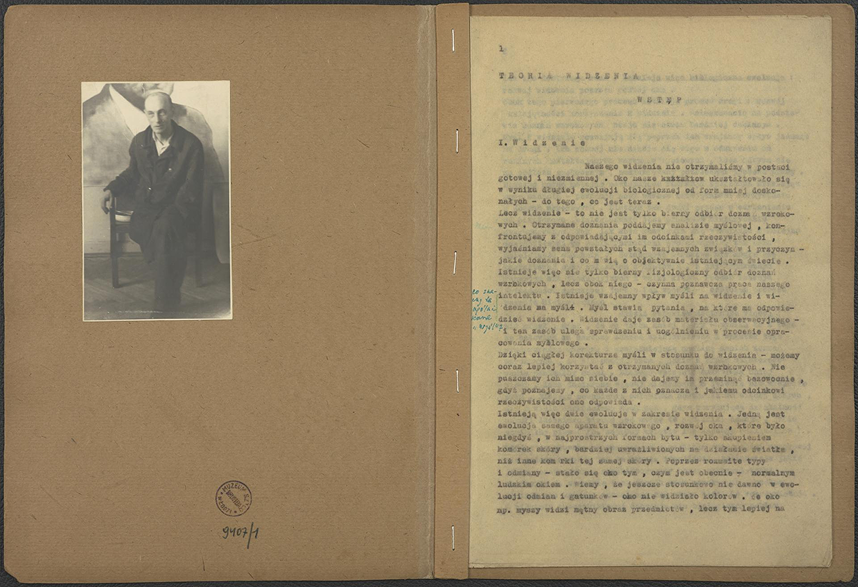
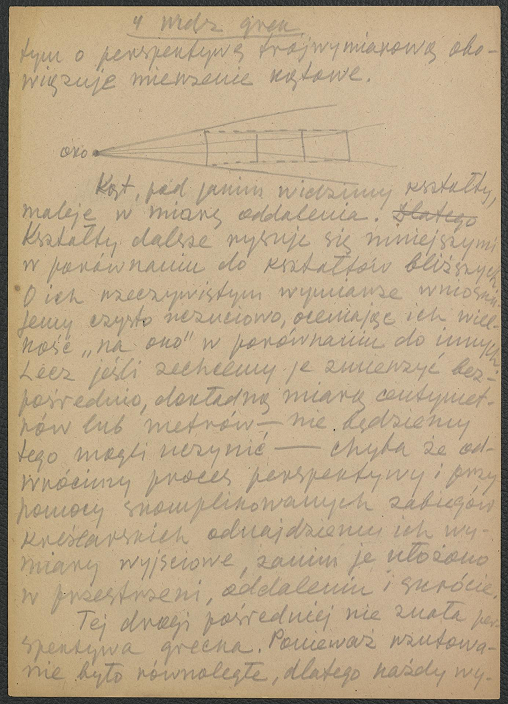
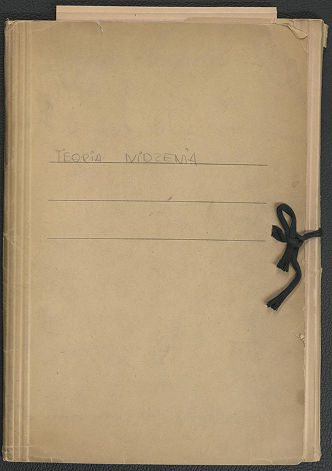
To date, there are two extant versions of Theory of Seeing: the 1958 publication (reissued in 1969 and 1974) and a later version published in 2016. An incomplete manuscript with accompanying drawings and illustrations (in their originals) can be found in the archives of the Museum of Art in Łódź. A second unfinished manuscript belongs to the collections of PAN Art Institute in Warsaw. A third manuscript, which appears to be the most complete, containing printed text alongside photos of the illustrations and notes by Strzemiński himself, is held in a private collection .
Luiza Nader,
Gradual Loss of Vision, 2025
Lorem ipsum dolor sit amet, consectetur adipiscing elit.
In its textual content, the new edition of Theory of Seeing is more or less consistent with its precursor: in addition to its text and illustrations (this time without annotations referring to the incomplete manuscript), the 2016 edition includes the article “Impressionist Seeing” first published in Odrodzenie in 1947. The illustrations, black-and-white in the previous edition, have been reproduced in color and, in certain cases, replaced altogether. Iwona Luba, editor of this edition and author of its introduction, suggests that Theory of Seeing was finished in 1947 and likely even submitted for publication before being redrafted while socialist realist policies were in force.[1] This claim seems to be corroborated by Strzemiński himself in the subtitle of his 1947 article on impressionism: “Chapter from a Forthcoming Book on Painting.”[2] Further supporting evidence can be found in two additional articles related to Theory of Seeing (published that same year) and in remarks made in 1958 by Julian Przyboś – Strzemiński’s friend and advocate (Przyboś’s comments, however, refer to 1949 rather than 1947). On these grounds, Luba asserts the intriguing hypothesis that an “original version” of the Theory was completed in 1947 but subsequently lost.[3]
This claim, however, is ultimately not supported by the facts. It does not help that Luba’s “Introduction to the New Edition” neglects to clarify the edition’s relation to the incomplete manuscript at the Museum of Art in Łódź, which contains brief passages missing from both editions (though by and large, the text coincides with the first edition). Nor does the introduction address the manuscript housed at the PAN Institute of Art in Warsaw (indeed, it does not so much as hint that this manuscript exists). Luba only accounts for the book’s illustrations, identifying them as Strzemiński’s own tracings – either carried over from the book’s first edition or obtained from the Documentation Department of the Museum of Art in Łódź (where they accompany the incomplete manuscript). While the first edition does present its illustrations as “author’s tracings,” this attribution should not be taken at face value. The drawings are not signed by Strzemiński and could plausibly be the handiwork of his students (the same is true of the drawings added to the new edition).[4] The assumption shared by both editions’ editors that the drawings are by Strzemiński’s hand is unsubstantiated. The new edition also neglects to acknowledge Stefan Krygier’s work on the manuscript (Krygier also co-authored Strzemiński’s article “Gothic Seeing” [Wizdenie gotyku] in 1947) and Julian Przyboś’s non-trivial role in Theory of Seeing’s publication in 1958. What became of the earlier manuscript submitted to the publishing house Wydawnictwo Literackie remains unclear. Stanisław Fijałkowski, who studied under Strzemiński at the time, has also pointed out that the second and third editions have a different cover that has no tangible connection to Strzemiński’s art, presumably due to the loss of Lech Kunka’s stunning design for the first edition.[5]
Luiza Nader,
Theory of Seeing:
Leading toward
Testimony, 2025
Vestibulum interdum magna ac tellus maximus tincidunt. Etiam sodales arcu sed aliquet vehicula. Mauris sed hendrerit augue. Etiam varius molestie tincidunt.
Luba’s admittedly electrifying hypothesis that Theory of Seeing was in fact finished and submitted for publication in 1947 before being lost and later revised (this time with the protective camouflage of Marxist terminology) does merit further investigation. In 1958, Przyboś (in a statement cited by Luba) claimed that the original version of Theory of Seeing had been finished nine years earlier, in 1949 (not 1947). According to anecdotal accounts by Stefan Morawski, Jerzy Oplustil, the artist’s daughter, and others, Strzemiński worked continuously on Theory of Seeing until his death. Even the extant text of Theory of Seeing suggests that the version consulted by its editors was simply incomplete. The text reads as an unfinished work (an impression acknowledged by Luba). The newest edition expands on its precursor by adding the above-mentioned article on impressionism. That said, in terms of its argument and rhetoric (such as the conspicuous absence of the otherwise pervasive Marxist language), the added article reads as an incongruent extension of the other chapters, despite certain uniform claims and concepts (the afterimage; physiological mobile seeing). What is more, Strzemiński’s course syllabi suggest that as an art history lecture series, “Theory of Seeing” did not end with an analysis of paintings by van Gogh (as it does in the first edition) or of Bonnard or Matisse (as it does in the last edition). The concluding lectures on cubism and surrealism have no corresponding parts in the editions of Theory of Seeing extant today.[6] In a 1958 review of Theory of Seeing, Przyboś mentions that Strzemiński sent a sizeable sample text from his Theory (roughly 100 pages) to editors of the magazine Twórczość [Art]. This text, of which we know little today, was lost when the magazine relocated from Krakow to Warsaw in 1950[7] (when Adam Ważyk served as its managing editor). Numerous veiled criticisms of socialist realism suggest that Theory of Seeing could not have been finished in 1947, when it was not yet clear which realist idiom would be championed in Poland, and when the specter of socialist realism was not as sharply defined as it would be in 1949-1950.Studies by Janusz Zagrodzki confirms the existence of a chapter on cubism. Zagrodzki cites letters written by Konrad Swinarski shortly after Strzemiński’s death: “I intended to send the next installment of Theory of Seeing” (October 26, 1953); “I’ll send cubism in a week at most – otherwise, I won’t manage” (April 6, 1954); “my concern is a transcript I urgently need. Orzechowska is going mad – she calls the school, left me paper, so I beg you, as soon as possible” (late 1954), and finally – “Barbara should be sending you the cubism transcript if not delivering it herself” (September 9, 1954).[8] In 2022, while browsing through Hanna Orzechowska's private archive, I discovered notes containing detailed outlines of Strzemiński's lectures from 1948 to 1949. Based on these records, the unpublished section of the Theory concerning the 20th century could be reconstructed. In Orzechowska’s collection, in addition to the third typescript version of Theoryof Seeing, a visual practice par excellence is also preserved: dozens of drawings with diagrams and explanations, largely, most probably, by Strzemiński himself. These images were probably used for lectures, displayed under an epidiascope[9].
[1] I. Luba, “Wprowadzenie,” p. 7-41.
[2] W. Strzemiński, “Widzenie impresjonistów (Rozdział książki o malarstwie mającej niebawem ukazać się w druku),” Odrodzenie 1947, no. 25, p. 4-5.
[3] I. Luba, “Wprowadzenie,” p. 13-14. This thesis is insufficiently substantiated. Luba claims that nothing remains of this alleged “original version” but the article “Widzenie impresjonistów.” This article, it is worth noting, was left out of the Theory’s first edition.
[4] In the article “Widzenie Greków,” Strzemiński gives credit to Lech Kunka and Andrzej Strumille: “In my approach to issues of Greek linearism and the formal attributes that distinguish it from later art, I received much help from L. Kunka. A mathematical account of the Greek line was developed by A. Strumiłło, whose work we make use of here.” This acknowledgment could refer to the article’s theoretical content or, alternatively, to the production of the drawings, where the line features prominently. W. Strzemiński, “Widzenie Greków” in Władysław Strzemiński. Wybór pism estetycznych, p. 163.
[5] Telephone conversation between Luiza Nader and Professor Stanisław Fijałkowski, January 2017.
[6] These syllabi can be consulted at the Academy of Fine Arts in Łódź. They appeared in an exhibition at Muzeum Sztuki in Łódź titled School years. Beginnings of the Strzemiński Academy of Fine Arts in Łódź (12.11.2015-1.31.2016). Strzemiński’s student Danuta Kula-Przyboś has confirmed that Strzemiński lectured on surrealism. Conversation between Luiza Nader and Danuta Kula-Przyboś, Warsaw 2016.
[7] J. Przyboś, “’Teoria widzenia’ Strzemińskiego” [Strzemiński’s Theory of Seeing], Przegląd Kulturalny 1958, no. 13, p. 7; while Iwona Luba cites this information, she does not consider how it undermines her claim that an original version of the Theory was complete by 1947, I. Luba, “Introduction,” p. 14.
[8] Swinarski’s statements are cited in Janusz Zagrodzki, Władysław Strzemiński. Obrazy słów, p. 18, footnote 17. As Zagrodzki notes, Swinarski’s letters are published in J. Majcherek, “Konrad Swinarski i grupa St-53” [Konrad Swinarski and the St-53 group], Teatr 1999, no. 6.
[9] I’m grateful to Dorota Jarecka for this comment.
A chapter from a book by Luiza Nader, Afekt Strzemińskiego. „Teoria widzenia”, rysunki wojenne, Pamięci przyjaciół – Żydów [Strzemiński’s Affect. “Theory of Seeing”, Wartime Drawings, In Memory of Friends – Jews], Wydawnictwo Instytutu Badań Literackich Polskiej Akademii Nauk– Muzeum Sztuki w Łodzi - Akademia Sztuk Pięknych w Warszawie, Warszawa – Łódź 2018.
Translation
Elisa Cushman – Rose